Introduction
If you want to get anywhere in chemistry or materials science, you need to understand how polymers are classified. It sounds simple, but this knowledge lets scientists and engineers predict what a material can do, pick the right one for a project, and dream up entirely new solutions for everything from medicine to electronics. Just look around—polymers are everywhere, showing up in your clothes, your phone, even your car.
But the way we organize and classify these giant molecules hasn’t always been the same. Early on, things were pretty basic. Now? We’ve got a whole toolbox of methods, each one revealing something new about a polymer’s structure, properties, and what it can actually do. In this guide, you’ll find 15 of the most reliable ways to classify polymers—techniques that have changed the game and can help you get a real edge in the field.
Whether you’re starting as a student, trying to level up your skills, or making big decisions in industry, wrapping your head around polymer classification will totally change how you think about and work with these fascinating materials.
Why Classification of Polymers Matters
Before diving into the specific methods, it’s essential to understand why the classification of polymers holds such tremendous importance in science and industry. Proper classification enables:
- Accurate material selection for specific applications
- Predictable performance characteristics under various conditions
- Efficient manufacturing processes tailored to polymer type
- Cost optimization through informed decision-making
- Innovation opportunities by understanding material limitations and possibilities
The classification of polymers serves as the foundation for a wide range of applications, from drug delivery systems to aerospace components, making it an indispensable tool for modern technology.
The 15 Guaranteed Methods for Classification of Polymers
1. Classification Based on Source or Origin
The most basic method of classifying polymers separates materials according to their origin. This technique separates polymers into three main groups:
Proteins, cellulose, starch, natural rubber, and nucleic acids are examples of natural polymers. Humans have been utilizing natural polymers for thousands of years, and they remain essential to biotechnology and the development of sustainable materials.
Semi-Synthetic Polymers: These materials, which include vulcanized rubber, cellulose acetate, and cellulose nitrate, are made by chemically altering natural polymers. This group of polymers fills the gap between materials that are completely synthetic and those that are natural.
Synthetic Polymers: Polyethylene, polyester, nylon, and polystyrene are examples of synthetic polymers that are entirely man-made through polymerization reactions. Because of their cost-effectiveness and customized qualities, these materials rule modern industry.
2. Classification Based on Structure
The structural type of polymers analyzes the polymer chain arrangement and is one of the most significant classification techniques:
Linear Polymers: Long, unbranched chains are the distinguishing feature of linear polymers, which include polyvinyl chloride (PVC) and high-density polyethylene (HDPE). Linear polymers tend to have greater tensile strength and crystallinity.
Branched Polymers: Characterized by side chains protruding from the main chain, branched polymers such as low-density polyethylene (LDPE) have varying mechanical and thermal properties than their linear equivalents.
Cross-Linked Polymers: Where polymer chains are cross-linked by covalent bonds, they form three-dimensional networks. Such polymers encompass materials such as vulcanized rubber and epoxy resins, which exhibit enhanced mechanical strength and resistance to chemicals.
Network Polymers: Extremely cross-linked structures consisting of intricate three-dimensional networks, e.g., bakelite and melamine formaldehyde, are the epitome of structural stiffness.
3. Classification Based on Thermal Behavior
The thermal classification of polymers divides materials based on their response to heat, one of the most practically relevant categorization methods:
Thermoplastics: These polymers soften upon heating and harden upon cooling repeatedly without significant chemical change. Examples include polyethylene, polypropylene, polystyrene, and PVC. Thermoplastics dominate the packaging, automotive, and consumer goods industries.
Thermosets: Once cured through heat or chemical reactions, thermosets cannot be remelted or reshaped. This classification of polymers includes epoxy resins, phenolic resins, and polyurethanes. They excel in high-temperature applications and structural components.
Elastomers: Exhibiting rubber-like elasticity, elastomers can stretch significantly and return to their original shape. Natural rubber, silicone rubber, and neoprene fall into this category, serving critical roles in seals, gaskets, and flexible components.
4. Classification Based on Polymerization Method
Understanding how polymers form provides another crucial dimension to the classification of polymers:
Addition Polymers: Formed through addition reactions without eliminating any molecules, these polymers include polyethylene, polypropylene, and polyvinyl chloride. The process involves opening double bonds and linking monomers together.
Condensation Polymers: Created through reactions that eliminate small molecules (typically water), condensation polymers include nylon, polyester, and polycarbonate. This classification of polymers typically results in materials with excellent mechanical properties.
Copolymers: When two or more different monomers combine, they create copolymers with properties distinct from either parent polymer. Examples include styrene-butadiene rubber (SBR) and acrylonitrile-butadiene-styrene (ABS).
5. Classification Based on Molecular Forces
The intermolecular forces governing polymer behavior provide another essential approach to the classification of polymers:
Elastomers, held together by weak van der Waals forces, exhibit high elasticity and flexibility. Their weak intermolecular forces allow chains to slide past each other easily.
Fibers: Strong intermolecular forces, particularly hydrogen bonding, characterize fiber-forming polymers like nylon, polyester, and Kevlar. This classification of polymers results in high tensile strength and crystallinity.
Thermoplastics: Intermediate intermolecular forces give thermoplastics their characteristic ability to soften upon heating while maintaining structural integrity at room temperature.
6. Classification Based on Crystallinity
The degree of molecular organization offers another perspective on the classification of polymers:
Crystalline Polymers: Featuring highly ordered, tightly packed molecular arrangements, crystalline polymers exhibit higher density, strength, and melting points. Examples include high-density polyethylene and polyethylene terephthalate (PET).
Amorphous Polymers: Lacking long-range molecular order, amorphous polymers like polystyrene and polymethyl methacrylate (PMMA) offer transparency and easier processing but generally lower mechanical strength.
Semi-Crystalline Polymers: Most polymers exist in this intermediate state, containing both crystalline and amorphous regions. This classification of polymers includes polypropylene and nylon, combining the advantages of both extremes.
7. Classification Based on Chain Growth Mechanism
The mechanism by which polymer chains grow during synthesis represents another technical approach to the classification of polymers:
Step-Growth Polymers: Growing through stepwise reactions between functional groups, these polymers include polyesters, polyamides, and polyurethanes. Molecular weight increases gradually throughout the reaction.
Chain-Growth Polymers: Initiated by reactive species (free radicals, ions, or catalysts), chain-growth polymers like polyethylene and polystyrene form rapidly once initiated. This classification of polymers typically yields high molecular weights quickly.
8. Classification Based on Backbone Composition
The chemical nature of the polymer backbone provides another fundamental approach to the classification of polymers:
Carbon Chain Polymers: Featuring only carbon atoms in the main chain, these polymers include polyethylene, polypropylene, and polystyrene. They dominate commodity plastics markets.
Heterochain Polymers: Incorporating heteroatoms (oxygen, nitrogen, sulfur) in the backbone, this classification of polymers includes polyesters, polyamides, and polyethers. They often exhibit superior thermal and chemical resistance.
Inorganic Polymers: With backbones containing no carbon atoms, inorganic polymers like silicones and polyphosphazenes offer unique properties for specialized applications.
9. Classification Based on Tacticity
The stereochemical arrangement of substituents along the polymer chain influences properties significantly:
Isotactic Polymers: All substituents are positioned on the same side of the chain, resulting in a regular structure and high crystallinity. This classification of polymers includes isotactic polypropylene, valued for its strength.
Syndiotactic Polymers: Substituents alternating regularly between sides create another ordered structure with distinct properties.
Atactic Polymers: Random substituent arrangement produces amorphous materials with lower strength but easier processing. Atactic polystyrene exemplifies this classification of polymers.
10. Classification Based on Application
Practical applications provide a market-oriented approach to the classification of polymers:
Commodity Polymers: High-volume, low-cost materials like polyethylene, polypropylene, and PVC serve everyday applications from packaging to construction.
Engineering Polymers: Higher-performance materials, including nylon, polycarbonate, and polyacetal, meet demanding mechanical requirements in automotive and industrial applications.
Specialty Polymers: High-value, specialized materials like fluoropolymers, liquid crystal polymers, and conductive polymers serve niche markets requiring unique properties.
11. Classification Based on Degradability
Environmental considerations have made degradability an increasingly important factor in the classification of polymers:
Biodegradable Polymers: Materials like polylactic acid (PLA), polyhydroxyalkanoates (PHA), and starch-based polymers break down naturally through biological processes.
Non-Biodegradable Polymers: Traditional plastics like polyethylene and polystyrene resist biological degradation, persisting in the environment for centuries.
Photodegradable Polymers: Designed to break down under UV radiation, these polymers offer controlled degradation for specific applications.
12. Classification Based on Functionality
The presence and nature of functional groups create another dimension for the classification of polymers:
Functional Polymers: Containing reactive groups like hydroxyl, carboxyl, or amino groups, these polymers enable further chemical modification and crosslinking.
Non-Functional Polymers: Lacking reactive groups, materials like polyethylene and polypropylene offer chemical inertness but limited modification potential.
Smart Polymers: Responding to environmental stimuli (temperature, pH, light), this emerging classification of polymers enables advanced applications in medicine and technology.
13. Classification Based on Molecular Architecture
Complex architectural features create sophisticated categories in the classification of polymers:
Star Polymers: Multiple chains radiating from a central core point offer unique rheological properties and high functionality.
Dendritic Polymers: Highly branched structures with controlled architecture serve as drug delivery vehicles and catalysts.
Block Copolymers: Sequential arrangements of different polymer segments create self-assembling materials with diverse applications from membranes to nanomaterials.
14. Classification Based on Electrical Properties
Electrical behavior represents another practical dimension for the classification of polymers:
Insulating Polymers: Materials like polyethylene and polystyrene with high electrical resistance dominate wire and cable applications.
Semiconducting Polymers: Conjugated polymers like polyacetylene and polythiophene enable organic electronics and sensors.
Conductive Polymers: Doped conjugated polymers offering electrical conductivity revolutionize flexible electronics and energy storage.
15. Classification Based on Mechanical Properties
Mechanical performance provides a final critical approach to the classification of polymers:
Rigid Polymers: High modulus materials like polystyrene and polycarbonate maintain shape under stress, serving structural applications.
Flexible Polymers: Low modulus materials like polyethylene films and silicone rubbers offer conformability and impact resistance.
High-Strength Polymers: Materials like aramid fibers (Kevlar) and ultra-high molecular weight polyethylene achieve exceptional tensile strength for demanding applications.
Comprehensive Comparison Table
| Classification Method | Primary Categories | Key Characteristics | Common Examples | Industrial Significance |
|---|---|---|---|---|
| Source/Origin | Natural, Semi-synthetic, Synthetic | Based on material origins | Cellulose, Cellulose acetate, Polyethylene | Sustainability considerations |
| Structure | Linear, Branched, Cross-linked, Network | Chain arrangement patterns | HDPE, LDPE, Epoxy, Bakelite | Mechanical properties prediction |
| Thermal Behavior | Thermoplastics, Thermosets, Elastomers | Response to heating | PP, Epoxy, Natural rubber | Processing method selection |
| Polymerization | Addition, Condensation, Copolymers | Formation mechanism | PE, Nylon, ABS | Synthesis pathway design |
| Molecular Forces | Elastomers, Fibers, Plastics | Intermolecular attraction strength | Rubber, Kevlar, PVC | Application domain targeting |
| Crystallinity | Crystalline, Amorphous, Semi-crystalline | Molecular ordering degree | HDPE, PS, PP | Performance optimization |
| Chain Growth | Step-growth, Chain-growth | Polymerization kinetics | Polyester, PE | Manufacturing control |
| Backbone Composition | Carbon chain, Heterochain, Inorganic | Main chain chemistry | PP, Nylon, Silicone | Chemical resistance properties |
Key Benefits of Understanding the Classification of Polymers
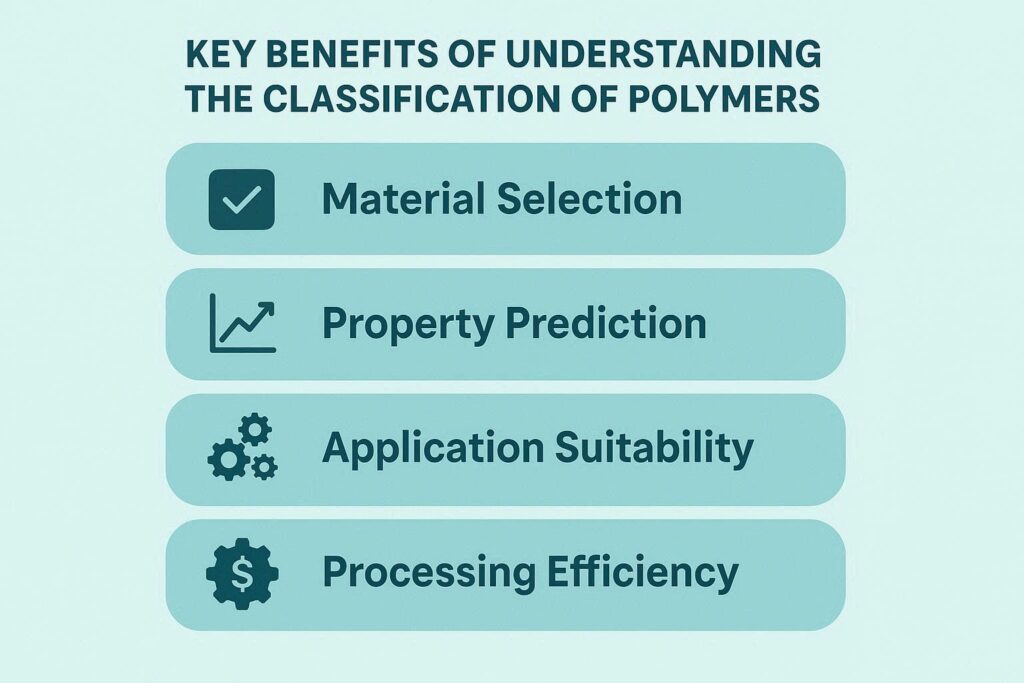
Mastering the classification of polymers delivers transformative advantages across multiple domains:
Enhanced Material Selection: By understanding various classification schemes, engineers can rapidly identify optimal materials for specific applications, reducing development time and costs.
Improved Performance Prediction: Different classification methods reveal how polymers will behave under various conditions, enabling more accurate performance forecasting.
Innovation Acceleration: Knowledge of polymer classification systems stimulates creativity by revealing gaps in current material offerings and opportunities for novel combinations.
Cost Optimization: Proper classification helps identify the most economical material meeting performance requirements, avoiding over-specification.
Sustainability Advancement: Understanding classification based on degradability and source enables more environmentally responsible material choices.
Quality Control Enhancement: Classification systems provide frameworks for consistent quality assessment and specification communication.
Regulatory Compliance: Many industries require specific polymer classifications for safety and regulatory purposes.
Practical Applications Across Industries
The classification of polymers impacts virtually every industry:
Automotive Industry: Engineers use thermal and mechanical classification to select materials for under-hood components, interior trim, and structural elements.
Medical Devices: Biocompatibility, sterilization compatibility, and degradability classifications guide material selection for implants, drug delivery systems, and surgical instruments.
Packaging Industry: Barrier properties, cost considerations, and recyclability drive classification-based decisions for food packaging, protective packaging, and consumer goods.
Electronics: Electrical property classifications determine material selection for insulators, semiconductors, and flexible circuit boards.
Aerospace: Weight-to-strength ratios, thermal stability classifications, and flame resistance guide material choices for aircraft components.
Construction: Weather resistance, thermal insulation properties, and durability classifications inform selection of pipes, insulation, and structural components.
Future Trends in Classification of Polymers
The field of polymer classification continues evolving with emerging technologies and priorities:
Sustainable Classification Systems: Growing environmental awareness drives the development of classification schemes emphasizing recyclability, biodegradability, and carbon footprint.
Smart Material Classifications: Responsive and adaptive polymers require new classification frameworks based on stimulus-response characteristics.
Nano-Scale Classifications: As polymers interact with nanomaterials, new classification systems addressing nano-scale properties emerge.
Computational Predictions: Machine learning and artificial intelligence enable classification based on predicted rather than measured properties.
Circular Economy Frameworks: Classification systems incorporating end-of-life considerations and recyclability become increasingly important.
Implementing Classification of Polymers in Your Work
Successfully applying polymer classification requires systematic approaches:
- Identify Key Requirements: Determine which properties matter most for your application
- Apply Relevant Classifications: Use classification methods most relevant to your requirements
- Cross-Reference Multiple Systems: Consider materials through multiple classification lenses
- Consult Technical Data: Verify classifications with manufacturer specifications
- Test and Validate: Confirm predicted behaviors through appropriate testing
- Document Decisions: Record classification rationale for future reference and optimization
Common Challenges and Solutions
Challenge: Multiple classification systems can create confusion.
Solution: Focus on classifications most relevant to your specific application domain and gradually expand knowledge.
Challenge: Materials may not fit neatly into single categories.
Solution: Recognize that many polymers exhibit characteristics spanning multiple classifications; use dominant features for primary categorization.
Challenge: Classification terminology varies across regions and industries.
Solution: Build familiarity with synonym relationships and maintain reference resources for terminology translation.
Challenge: New polymer types may not fit existing classification schemes.
Solution: Stay current with evolving classification frameworks and participate in professional communities discussing emerging materials.
Conclusion
The classification of polymers represents far more than an academic exercise—it serves as an essential tool transforming how we understand, select, and apply these versatile materials. The 15 methods explored in this comprehensive guide provide multiple perspectives for examining polymers, each revealing unique insights into material behavior and potential applications.
From the fundamental distinction between natural and synthetic polymers to sophisticated classifications based on molecular architecture and electrical properties, each system contributes to a holistic understanding of these remarkable materials. The classification of polymers enables engineers to predict performance, select optimal materials, drive innovation, and solve complex challenges across countless industries.
As polymer science continues advancing with smart materials, sustainable alternatives, and nanoscale innovations, classification systems will evolve to accommodate these developments. However, the fundamental principle remains constant: proper classification of polymers empowers informed decision-making and accelerates progress in materials science and engineering.
Whether you’re developing next-generation medical devices, optimizing packaging solutions, or pioneering sustainable materials, mastering the classification of polymers provides the foundation for success. By understanding these 15 guaranteed methods, you’ve equipped yourself with knowledge that truly transforms how you approach polymer science and materials engineering.
Frequently Asked Questions (FAQ)
What is the most important classification of polymers?
No single classification method is universally most important—the relevance depends on your specific application. For processing engineers, thermal behavior classification (thermoplastics vs. thermosets) is often crucial. For product designers, mechanical property classifications may be paramount. For sustainability professionals, source and degradability classifications matter most. The best approach is understanding multiple classification systems and applying those most relevant to your needs.
How does the classification of polymers help in material selection?
Classification of polymers streamlines material selection by organizing thousands of available materials into manageable categories based on specific properties. By identifying which classification categories align with your requirements (e.g., high-temperature resistance, flexibility, biodegradability), you can quickly narrow options from thousands of polymers to a handful of candidates, then make final selections based on detailed specifications, cost, and availability.
What is the difference between thermoplastics and thermosets?
This represents one of the most fundamental distinctions in thermal classification of polymers. Thermoplastics soften when heated and harden when cooled, allowing reshaping through multiple heating cycles without significant chemical change—examples include polyethylene and polystyrene. Thermosets undergo irreversible chemical reactions during curing, forming permanent cross-linked structures that cannot be remelted or reshaped—examples include epoxy resins and vulcanized rubber. This difference profoundly impacts processing methods, recyclability, and application suitability.
Can a polymer belong to multiple classification categories?
Absolutely. Most polymers simultaneously belong to multiple classification categories because different classification systems examine different aspects of polymer characteristics. For example, polyethylene terephthalate (PET) is simultaneously a synthetic polymer (by source), linear polymer (by structure), thermoplastic (by thermal behavior), condensation polymer (by polymerization method), semi-crystalline polymer (by crystallinity), and fiber or plastic (by application). This multi-dimensional classification provides comprehensive understanding of material behavior.
What are commodity polymers versus engineering polymers?
This application-based classification of polymers distinguishes materials by performance requirements and cost. Commodity polymers like polyethylene, polypropylene, and PVC are produced in massive volumes at low cost for everyday applications—packaging, containers, and basic construction materials. Engineering polymers like nylon, polycarbonate, and polyacetal offer superior mechanical, thermal, or chemical properties for demanding applications—automotive components, industrial equipment, and precision parts. Engineering polymers typically cost significantly more but deliver performance justifying the premium in critical applications.
How does polymer crystallinity affect properties?
Crystallinity represents one of the most influential factors in the classification of polymers. Crystalline regions feature highly ordered molecular arrangements, resulting in higher density, strength, stiffness, chemical resistance, and higher melting points. Amorphous regions lack long-range order, providing transparency, flexibility, and easier processing. Most polymers are semi-crystalline, containing both regions. High-density polyethylene (HDPE) with higher crystallinity offers greater strength and heat resistance than low-density polyethylene (LDPE) with lower crystallinity, despite identical chemical composition.
What are biodegradable polymers and how are they classified?
Biodegradable polymers represent an increasingly important category in environmental classification of polymers. These materials break down through biological processes involving microorganisms, enzymes, or environmental conditions. Classifications include naturally occurring biodegradable polymers (cellulose, starch, proteins), synthetic biodegradable polymers (polylactic acid, polyglycolic acid, polycaprolactone), and biodegradable blends. Biodegradation rates and conditions vary significantly—some require industrial composting facilities, while others degrade in soil or marine environments. This classification becomes crucial for sustainable product design and waste management strategies.
How do addition and condensation polymerization differ?
This classification of polymers by polymerization method reflects fundamental differences in how polymer chains form. Addition polymerization involves monomers with double bonds that open and link together without eliminating any atoms—the final polymer contains all atoms from the original monomers. Examples include polyethylene and polystyrene. Condensation polymerization involves reactions between functional groups that eliminate small molecules (usually water)—the polymer contains fewer atoms than the starting monomers. Examples include nylon and polyester. These mechanisms influence molecular weight distribution, functional group presence, and polymerization kinetics, affecting both manufacturing processes and material properties.
What role does tacticity play in polymer properties?
Tacticity describes the stereochemical arrangement of substituents along the polymer backbone, representing a sophisticated structural classification of polymers. Isotactic polymers have all substituents on the same side, creating regular structure that promotes crystallinity and results in higher melting points, strength, and stiffness—isotactic polypropylene is a strong, heat-resistant material. Atactic polymers have randomly arranged substituents, producing amorphous structure with lower mechanical properties but easier processing—atactic polystyrene is commonly used for disposable items. Syndiotactic polymers have alternating substituent arrangements, offering intermediate properties. This classification significantly impacts commercial value and application suitability.
How is the classification of polymers evolving with new technologies?
The classification of polymers continuously evolves to accommodate emerging materials and priorities. Recent developments include classifications for smart or stimuli-responsive polymers (responding to temperature, pH, light, or other triggers), conductive and semiconductive polymers for electronics applications, self-healing polymers that repair damage autonomously, and polymers with programmable properties at the molecular level. Additionally, sustainability concerns drive new classification frameworks emphasizing carbon footprint, recyclability, and circular economy potential. Machine learning and computational chemistry enable classification based on predicted rather than empirically measured properties, accelerating material discovery and development. As polymer science advances, classification systems adapt to capture new dimensions of material behavior and performance.