Introduction
Imagine a world without metals. No smartphones, no airplanes, no bridges, and no modern infrastructure. The properties of metals have fundamentally shaped human civilization for thousands of years, from the Bronze Age to today’s technological revolution. These remarkable materials possess unique characteristics—strength, conductivity, malleability, and durability—that make them indispensable in virtually every industry.
What makes metals so special? The answer lies in their extraordinary physical and chemical properties of metals that set them apart from other materials. Whether it’s the highest melting point metal tungsten withstanding extreme temperatures in light bulb filaments, or copper’s exceptional electrical conductivity powering our homes, metals continue to drive innovation across countless applications.
In this comprehensive guide, we’ll explore 12 game-changing uses of metals that have revolutionized our world. You’ll discover how the fundamental properties of metals enable these applications, learn about real-world examples, and understand why these materials remain irreplaceable in modern society. From aerospace engineering to medical breakthroughs, the versatility of metals knows no bounds.
Let’s dive into the fascinating world of metallic materials and uncover how their unique properties continue to transform industries and improve our daily lives.
Understanding the Fundamental Properties of Metals
Before exploring specific applications, it’s crucial to understand what makes metals so versatile. The properties of metals can be categorized into physical, chemical, and mechanical characteristics that define their behavior and suitability for various uses.
Physical Properties of Metals
The physical properties of metals include:
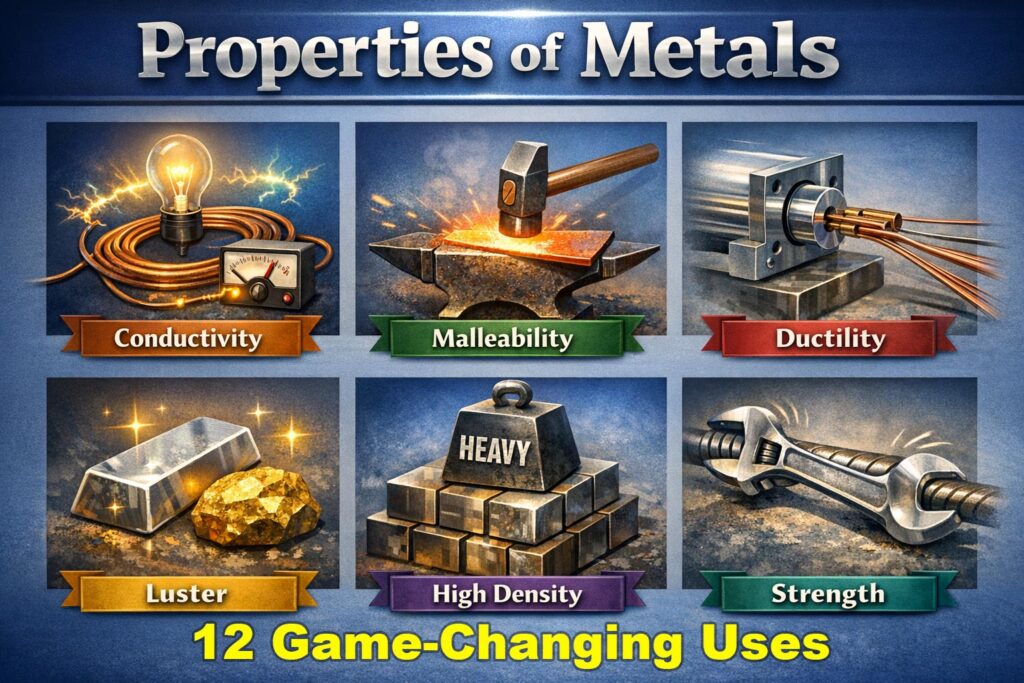
- Metallic luster: Metals have a characteristic shiny appearance due to their ability to reflect light effectively
- High density: Most metals are dense materials, making them suitable for applications requiring weight and stability
- Melting and boiling points: Many metals have high melting points, with the highest melting point metal being tungsten at 3,422°C (6,192°F)
- Thermal conductivity: Metals efficiently transfer heat, making them ideal for cooking utensils and heat exchangers
- Electrical conductivity: The free electrons in metallic structures allow excellent electrical current flow
Mechanical Properties of Metals
The mechanical properties of metals determine how they respond to forces:
- Malleability: Metals can be hammered or rolled into thin sheets without breaking
- Ductility: Metals can be drawn into wires, essential for electrical applications
- Tensile strength: The ability to withstand pulling forces without breaking
- Hardness: Resistance to scratching, indentation, or deformation
- Elasticity: The capacity to return to its original shape after deformation
Chemical Properties of Metals
The chemical properties of metals influence their reactivity and stability:
- Corrosion resistance: Some metals, like gold and platinum, resist oxidation, while others, like iron, rust easily
- Reactivity: Metals vary in their tendency to form compounds with other elements
- Oxide formation: Most metals form protective oxide layers when exposed to air
Understanding these properties of metals is fundamental to appreciating why certain metals excel in specific applications.
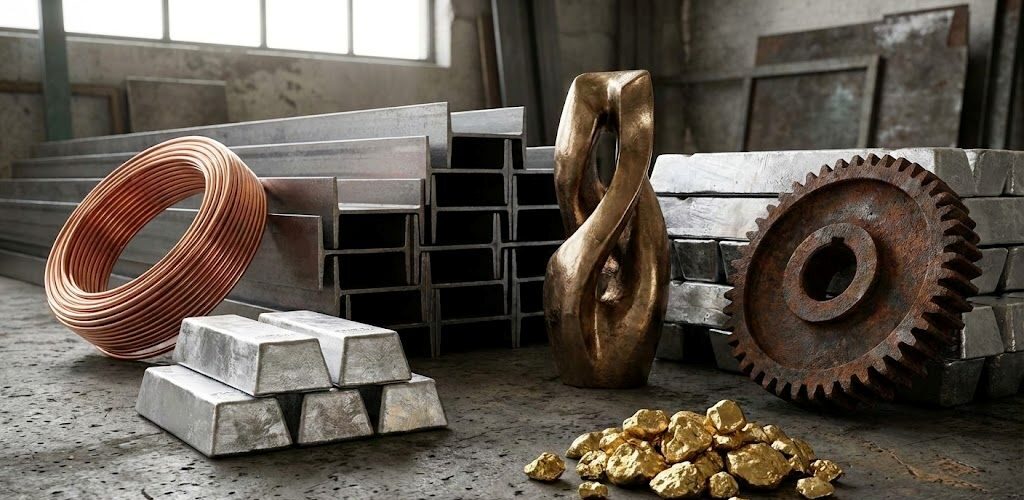
12 Game-Changing Uses of Metals
1. Aerospace Engineering: Lightweight Strength Takes Flight
The aerospace industry relies heavily on the exceptional properties of metals to build aircraft and spacecraft that can withstand extreme conditions. Aluminum alloys dominate aircraft construction due to their impressive strength-to-weight ratio, while titanium’s superior strength and corrosion resistance make it perfect for jet engine components.
Key applications:
- Aircraft fuselages and wings (aluminum alloys)
- Jet engine turbine blades (titanium and nickel-based superalloys)
- Spacecraft heat shields (materials that can withstand temperatures approaching the highest melting point metal tungsten)
- Landing gear components (high-strength steel alloys)
The properties of metals like high melting points, low density, and structural integrity enable aircraft to operate safely at altitudes where temperatures can fluctuate from -60°C to extreme heat during re-entry. For instance, the SR-71 Blackbird used titanium extensively because conventional aluminum would have failed at the high temperatures generated by supersonic flight.
Real-world impact: Modern commercial aircraft like the Boeing 787 Dreamliner use advanced metal composites that reduce fuel consumption by 20%, directly contributing to lower emissions and operational costs.
2. Medical Devices: Biocompatible Metals Saving Lives
The unique properties of metals have revolutionized modern medicine, enabling life-saving procedures and long-term implants that improve quality of life for millions. Medical-grade metals must possess specific characteristics: biocompatibility, corrosion resistance, and appropriate mechanical strength.
Critical medical applications:
- Surgical instruments: Stainless steel’s corrosion resistance and sterilizability make it ideal for scalpels, forceps, and scissors
- Joint replacements: Titanium and cobalt-chromium alloys provide durable, biocompatible hip and knee implants
- Dental implants: Titanium’s osseointegration properties allow it to bond directly with bone tissue
- Pacemakers and stents: Platinum and platinum-iridium alloys offer excellent conductivity and biocompatibility
The properties of metals like titanium’s ability to integrate with human bone tissue have made joint replacement surgeries routine procedures with success rates exceeding 95%. Over 1 million hip and knee replacements are performed annually in the United States alone, restoring mobility to patients with severe arthritis or injuries.
Innovation spotlight: Nitinol, a nickel-titanium alloy with shape-memory properties, is used in self-expanding stents that can be inserted through small incisions and expand to their predetermined shape at body temperature.
3. Electronics and Computing: Conductivity Powering the Digital Age
The electrical properties of metals form the foundation of our digital world. Without metals like copper, silver, and gold, modern electronics simply wouldn’t exist. These metals’ exceptional conductivity enables the flow of electrons that powers everything from smartphones to supercomputers.
Essential electronic applications:
- Circuit boards: Copper traces conduct electrical signals between components
- Connectors and contacts: Gold plating prevents corrosion and ensures reliable connections
- Semiconductors: Aluminum and copper interconnects in microchips
- Batteries: Lithium, cobalt, and nickel in rechargeable battery technologies
Copper remains the most widely used metal in electronics due to its excellent conductivity and cost-effectiveness. A typical smartphone contains approximately 15 grams of copper in various components, while a single computer may contain over 1 kilogram.
The properties of metals at the nanoscale have enabled the miniaturization of electronics. Modern processors contain transistors with metal components just 5 nanometers wide—about 10,000 times thinner than a human hair.
Future outlook: The demand for rare earth metals in electronics continues to grow, with applications in renewable energy technologies, electric vehicles, and advanced computing systems driving innovation in metal recovery and recycling.
4. Construction and Infrastructure: Structural Integrity at Scale
The properties of metals provide the strength and durability required for modern construction. Steel, in particular, revolutionized architecture by enabling skyscrapers, long-span bridges, and massive infrastructure projects that define our cities.
Major construction applications:
- Structural steel: Building frames, bridges, and support beams
- Reinforcement bars (rebar): Strengthening concrete structures
- Roofing and cladding: Aluminum and steel for weather protection
- Fasteners and hardware: Stainless steel bolts, nails, and connectors
Steel’s tensile strength allows buildings to reach unprecedented heights. The Burj Khalifa, the world’s tallest building at 828 meters, uses approximately 31,400 metric tons of steel reinforcement. The properties of metals like steel’s ductility and strength make such engineering marvels possible.
Sustainability consideration: Modern construction increasingly uses recycled steel, which retains all the properties of metals found in virgin material while reducing environmental impact. Steel is the most recycled material on Earth, with recycling rates exceeding 85% in many applications.
5. Automotive Industry: Performance, Safety, and Efficiency
The automotive sector leverages diverse properties of metals to balance performance, safety, fuel efficiency, and cost. Different metals serve specific purposes throughout vehicle construction, from the engine to the body panels.
Automotive metal applications:
- Engine blocks: Aluminum and cast iron for heat dissipation and durability
- Body panels: Steel, aluminum, and magnesium alloys for strength and weight reduction
- Exhaust systems: Stainless steel for corrosion resistance at high temperatures
- Catalytic converters: Platinum, palladium, and rhodium for emissions control
The shift toward electric vehicles (EVs) has changed metal requirements significantly. EVs require more copper (approximately 83 kg per vehicle compared to 23 kg in conventional cars) due to extensive wiring and electric motor components. The properties of metals like copper’s conductivity are essential for EV performance and charging efficiency.
Safety innovation: Advanced high-strength steel (AHSS) provides better crash protection while reducing vehicle weight. These specialized alloys demonstrate how optimizing the properties of metals can achieve multiple objectives simultaneously.
6. Energy Generation and Storage: Powering Our Future
The transition to renewable energy depends heavily on the unique properties of metals. From solar panels to wind turbines and battery storage systems, metals enable clean energy generation and efficient power distribution.
Energy sector applications:
- Solar panels: Silicon with silver contacts for photovoltaic cells
- Wind turbines: Steel towers, copper generators, and rare earth magnets
- Nuclear reactors: Zirconium alloys and stainless steel for fuel rods and containment
- Power transmission: Aluminum and copper in high-voltage cables
The highest melting point metal, tungsten, plays a crucial role in traditional power generation through its use in high-temperature applications. Meanwhile, lithium and cobalt are critical for battery storage systems that stabilize renewable energy grids.
Grid-scale innovation: Vanadium redox flow batteries utilize the properties of metals like vanadium’s multiple oxidation states to store large amounts of energy for extended periods, addressing renewable energy’s intermittency challenge.
7. Food and Beverage Industry: Preservation and Safety
The properties of metals ensure food safety, preservation, and quality throughout the supply chain. Metals must be non-reactive, corrosion-resistant, and able to withstand repeated cleaning and sterilization.
Food industry metal applications:
- Canning: Tin-plated steel and aluminum for long-term food preservation
- Processing equipment: Stainless steel for hygiene and corrosion resistance
- Cookware: Aluminum, copper, and stainless steel for heat distribution
- Refrigeration systems: Copper tubing and aluminum fins for heat exchange
Stainless steel dominates commercial food processing because its properties of metals include excellent corrosion resistance, ease of cleaning, and inability to react with acidic foods. The material’s chromium content forms a protective oxide layer that prevents contamination.
Historical impact: The development of canning technology using metal containers revolutionized food preservation in the 19th century, enabling longer supply chains and reducing food waste. Today, aluminum cans are recycled infinitely without losing the properties of metals that make them ideal for food storage.
8. Marine and Offshore Applications: Withstanding Harsh Environments
Marine environments present unique challenges that require metals with exceptional properties of metals including superior corrosion resistance, strength, and durability. Saltwater’s corrosive nature demands specialized materials that can perform reliably for decades.
Marine sector applications:
- Ship hulls and structures: Marine-grade aluminum and steel alloys
- Propellers and shafts: Bronze and stainless steel for strength and corrosion resistance
- Offshore platforms: High-strength steel for oil and gas extraction
- Desalination plants: Titanium and nickel alloys for seawater processing
Titanium’s remarkable properties of metals—specifically its excellent corrosion resistance in seawater and high strength-to-weight ratio—make it ideal for submarine hulls, underwater equipment, and marine fasteners. Naval vessels increasingly use titanium components to reduce weight while maintaining structural integrity.
Economic significance: The offshore wind energy sector requires massive amounts of steel—a single 8 MW wind turbine foundation uses approximately 500-800 tons of steel, highlighting how the properties of metals enable renewable energy infrastructure in challenging marine environments.
9. Chemical Processing: Resistance to Extreme Conditions
Chemical manufacturing requires materials that can withstand corrosive substances, extreme temperatures, and high pressures. The properties of metals like chemical inertness and high melting points are essential for safe and efficient chemical production.
Chemical industry metal applications:
- Reaction vessels: Stainless steel, titanium, and exotic alloys
- Heat exchangers: Copper and specialized alloys for thermal management
- Piping systems: Hastelloy and other nickel-based alloys for corrosive chemicals
- Catalysts: Platinum, palladium, and rhodium for chemical reactions
Tantalum, which has one of the highest melting points among metals (approaching the highest melting point metal tungsten), is used in chemical processing equipment handling extremely corrosive acids. Its properties of metals include exceptional resistance to chemical attack at high temperatures.
Process optimization: The chemical industry’s continuous operation requirements demand metals that maintain their properties of metals under stress for years without failure, driving innovation in alloy development and surface treatments.
10. Defense and Military: Strength Under Extreme Conditions
Military applications demand metals with the most demanding properties of metals: extreme strength, heat resistance, impact resistance, and often specialized characteristics like radar absorption or thermal management.
Defense sector applications:
- Armor plating: Hardened steel and ceramic-metal composites
- Ammunition: Brass casings, lead projectiles, and depleted uranium penetrators
- Aircraft components: Titanium and aluminum alloys for stealth fighters
- Naval vessels: High-strength steel and aluminum for destroyers and carriers
The development of armor-piercing ammunition demonstrates how understanding the properties of metals enables technological advancement. Tungsten and depleted uranium are used in kinetic energy penetrators because their high density and strength, combined with melting points approaching the highest melting point metal, allow them to penetrate hardened steel armor.
Advanced materials: Modern military aircraft like the F-35 use titanium extensively—comprising about 27% of the aircraft’s structural weight—because the properties of metals like titanium’s strength, light weight, and heat resistance are crucial for supersonic flight and combat maneuverability.
11. Jewelry and Precious Metals: Beauty and Value
The aesthetic and chemical properties of metals have made certain metals highly valued throughout human history. Gold, silver, and platinum’s resistance to corrosion, combined with their beauty and rarity, make them perfect for jewelry and as stores of value.
Precious metal applications:
- Fine jewelry: Gold, silver, platinum, and palladium
- Investment: Bullion bars and coins as financial assets
- Industrial uses: Gold in electronics, silver in photography and medical applications
- Dentistry: Gold and platinum alloys for dental crowns and bridges
Gold’s unique properties of metals include its malleability (one gram can be beaten into a sheet covering one square meter), non-reactivity, and distinctive color. These characteristics have made gold a symbol of wealth and power across cultures for over 5,000 years.
Market dynamics: The global jewelry market consumes approximately 2,000 tons of gold annually, while industrial applications account for another 300 tons, demonstrating how the properties of metals like gold’s conductivity and corrosion resistance make it valuable beyond its aesthetic appeal.
12. Advanced Manufacturing: Precision and Innovation
Modern manufacturing techniques like additive manufacturing (3D printing), precision machining, and nanotechnology rely on understanding and manipulating the properties of metals at unprecedented scales.
Advanced manufacturing applications:
- 3D-printed metal parts: Titanium and aluminum alloys for aerospace and medical devices
- Cutting tools: Tungsten carbide and cobalt alloys for machining
- Molds and dies: Tool steels with precise properties of metals for manufacturing
- Nanotechnology: Metal nanoparticles for catalysis, sensors, and medicine
Metal 3D printing has revolutionized prototyping and production by enabling complex geometries impossible with traditional methods. The properties of metals remain consistent whether parts are cast, machined, or additively manufactured, though microstructure differences can affect performance.
Tungsten’s status as the highest melting point metal makes it essential for cutting tools and industrial applications requiring extreme heat resistance. Tungsten carbide tools can machine steel at speeds generating temperatures exceeding 1,000°C without degrading.
Industry 4.0 integration: Smart manufacturing systems now monitor the properties of metals during production in real-time, using sensors to detect defects and optimize processes, ensuring consistent quality and reducing waste.
The Science Behind Metal Properties
Understanding why metals possess their unique properties of metals requires examining their atomic structure. Metals form crystalline structures where atoms arrange in regular, repeating patterns called crystal lattices. This organization creates a “sea” of free electrons that move throughout the structure, explaining many key metal characteristics.
Why Do Metals Conduct Electricity?
The free electrons in metallic structures can move easily when voltage is applied, creating electrical current. This explains why copper and silver are excellent conductors—their atomic structure allows maximum electron mobility. The properties of metals like conductivity directly result from this electron arrangement.
What Determines Melting Points?
The highest melting point metal, tungsten, has strong metallic bonds between atoms requiring enormous energy to break. Melting point depends on:
- Strength of metallic bonding
- Number of valence electrons
- Atomic size and packing efficiency
- Crystal structure type
Metals with higher melting points generally have more stable crystal structures and stronger atomic bonds.
How Do Alloys Enhance Metal Properties?
Alloying—combining two or more metals—allows engineers to customize the properties of metals for specific applications. Steel (iron with carbon) is stronger than pure iron. Bronze (copper with tin) is harder than pure copper. Modern superalloys used in jet engines combine multiple elements to achieve properties of metals that no single element possesses.
Environmental Considerations and Sustainability
The extraction, processing, and use of metals have significant environmental impacts. However, the recyclability of metals offers substantial sustainability advantages. Unlike many materials, metals retain their properties of metals after recycling, allowing infinite reuse.
Metal Recycling Statistics
- Aluminum: Recycling saves 95% of the energy required for primary production
- Steel: Most recycled material globally, with over 630 million tons recycled annually
- Copper: Approximately 80% of all copper ever mined is still in use today
- Precious metals: Gold and platinum recovery rates exceed 90% from electronic waste
The circular economy model for metals recognizes that the properties of metals don’t degrade through recycling, making them ideal candidates for sustainable material management.
Green Mining and Processing
Modern mining operations increasingly focus on reducing environmental impact through:
- More efficient extraction methods minimize waste
- Water recycling and treatment systems
- Renewable energy powering operations
- Restoration of mining sites after closure
Future Trends in Metal Applications
Emerging Technologies
High-entropy alloys: These materials combine five or more elements in equal proportions, creating properties of metals that exceed conventional alloys in strength, temperature resistance, and corrosion resistance.
Shape-memory alloys: Metals that “remember” their original shape and return to it when heated have applications in aerospace, medicine, and robotics.
Metallic glass: Amorphous metal alloys lacking crystalline structure exhibit unique properties of metals, including exceptional strength and corrosion resistance.
Space Exploration
Future space missions will require metals with exceptional properties of metals to withstand cosmic radiation, extreme temperatures, and micrometeorite impacts. Research into materials approaching the highest melting point metal tungsten’s characteristics continues for next-generation spacecraft thermal protection systems.
Biomedical Innovation
Researchers are developing biodegradable metal implants that dissolve harmlessly after healing occurs, eliminating the need for removal surgery. Magnesium alloys show promise because they possess appropriate properties of metals including biocompatibility and strength, while naturally corroding in the body.
Frequently Asked Questions (FAQs)
| Question | Answer |
|---|---|
| What are the most important properties of metals? | The most important properties of metals include electrical and thermal conductivity, malleability, ductility, metallic luster, high tensile strength, and corrosion resistance. These properties make metals suitable for applications ranging from construction to electronics. |
| Which metal has the highest melting point? | Tungsten holds the record as the highest melting point metal at 3,422°C (6,192°F). This property makes tungsten ideal for applications requiring extreme heat resistance, such as light bulb filaments, rocket nozzles, and high-temperature furnaces. |
| Why are metals good conductors of electricity? | Metals conduct electricity well because of their atomic structure, which features free-moving electrons. These electrons can flow easily through the metal when voltage is applied, creating an electrical current. Copper and silver are among the best conductors due to their electron configurations. |
| Can metals be recycled without losing their properties? | Yes, metals retain their fundamental properties of metals after recycling. Steel, aluminum, copper, and precious metals can be recycled indefinitely without degradation, making them highly sustainable materials. This recyclability is a major environmental advantage of metals. |
| What makes some metals more expensive than others? | Metal prices depend on rarity, extraction difficulty, demand, and the unique properties of metals. Precious metals like platinum and gold are rare and difficult to mine. Industrial metals like titanium require energy-intensive processing. Metals with specialized properties of metals command premium prices. |
| Are all metals magnetic? | No, only certain metals exhibit magnetic properties. Iron, nickel, and cobalt are ferromagnetic at room temperature. Most other metals are non-magnetic or only weakly magnetic. This property affects how metals are used in applications like electric motors and data storage. |
| What is the difference between pure metals and alloys? | Pure metals consist of a single element, while alloys combine two or more elements to achieve enhanced properties of metals. Alloys typically offer improved strength, corrosion resistance, or other characteristics that pure metals lack. Steel, bronze, and brass are common alloys. |
| How do temperature extremes affect metal properties? | Temperature significantly impacts the properties of metals. High temperatures can reduce strength and cause melting (except for metals approaching the highest melting point metal like tungsten). Very low temperatures can make some metals brittle. Engineers must consider operating temperatures when selecting metals. |
| Why is titanium used in medical implants? | Titanium is ideal for medical implants due to its biocompatibility, corrosion resistance, and ability to osseointegrate (bond with bone). These properties of metals make titanium safe for long-term implantation, with low risk of rejection or adverse reactions in the human body. |
| What role do metals play in renewable energy? | Metals are essential for renewable energy systems. Solar panels use silver and aluminum, wind turbines require copper and rare earth metals, and batteries need lithium, cobalt, and nickel. The unique properties of metals enable efficient energy generation, storage, and distribution in sustainable systems. |
Conclusion
The properties of metals have enabled virtually every technological advancement in human history. From ancient bronze tools to modern spacecraft, these remarkable materials continue to drive innovation across industries. We’ve explored 12 game-changing uses that demonstrate why metals remain irreplaceable in our modern world.
Understanding the fundamental properties of metals—their strength, conductivity, malleability, and durability—helps us appreciate their versatility. Whether it’s the highest melting point metal, tungsten, withstanding extreme temperatures, or gold’s corrosion resistance, making it perfect for both jewelry and electronics, each metal’s unique characteristics serve specific purposes.
As we face future challenges in sustainability, space exploration, and technological advancement, metals will undoubtedly play a central role. The ability to recycle metals infinitely without losing their properties of metals positions them as sustainable materials for generations to come. Innovations in alloy development, processing techniques, and applications continue to unlock new possibilities.
Key takeaways to remember:
The properties of metals are determined by their atomic structure and electron configuration, giving them characteristics no other material class can match. These properties enable applications that shape our daily lives—from the buildings we live in to the devices we use, the vehicles we drive, and the medical treatments that save lives.
Understanding and leveraging the properties of metals will remain crucial as humanity advances. Whether you’re an engineer, student, business professional, or simply curious about the materials that build our world, appreciating what makes metals special helps you make informed decisions and recognize the innovation happening around you.
Take action today: Look around your environment and identify the metals in everyday objects. Consider their properties of metals and why they were chosen for those specific applications. This awareness will deepen your understanding of material science and the engineering decisions that shape our technological landscape.
The future of metals is bright, with new alloys, applications, and processing methods constantly emerging. As we continue to push the boundaries of what’s possible, the fundamental properties of metals will keep enabling breakthroughs that improve lives and advance civilization.