
Look around you. The screen you are reading this on, the chair you are sitting in, the clothes on your back, and even the contact lenses in your eyes—they all share a hidden commonality. They are materials built from giant molecules called polymers. But these giant molecules didn’t just appear out of thin air. They were constructed, brick by brick, from smaller, simpler units. These units are the building blocks of polymers.
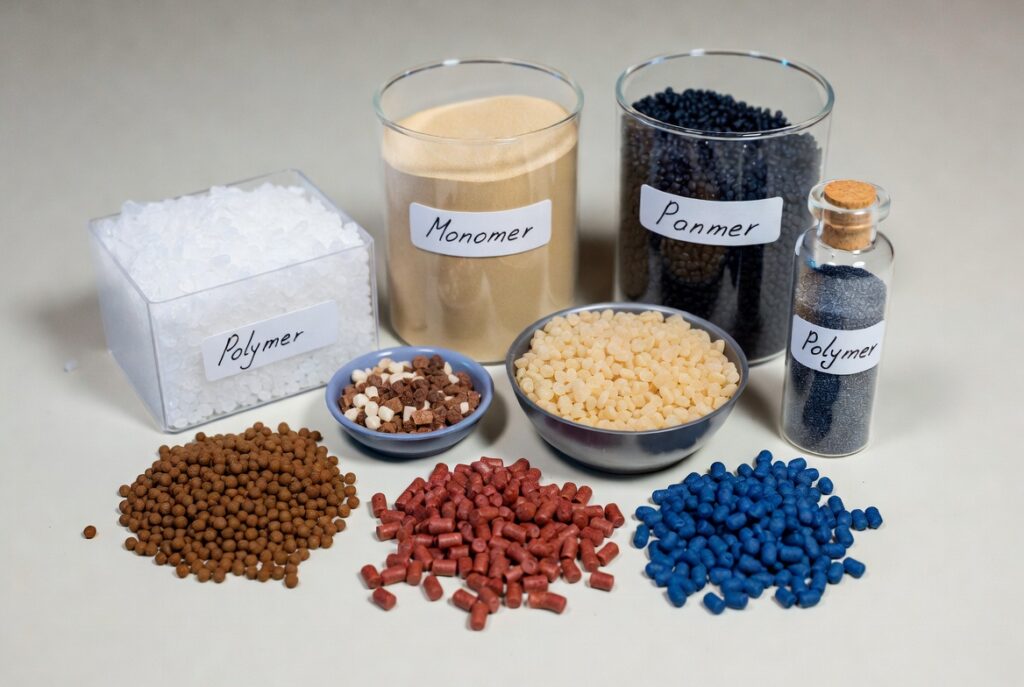
In the world of chemistry and materials science, these building blocks of polymers are called monomers. The word comes from the Greek mono (one) and meros (part). When you string thousands of these “one parts” together, you get a poly (many) mer. It is the ultimate Lego set of the universe. By changing the shape, size, and chemical nature of these individual bricks, scientists can create materials that are harder than steel, lighter than air, or elastic enough to stretch ten times their length.
Why does this matter to you? Because we are living in the Polymer Age. Understanding the building blocks of polymers is the key to understanding the global economy, the environmental crisis, and the future of technology. Whether you are a chemistry student struggling with organic structures, an investor looking at the petrochemical market, or a conscious consumer worried about microplastics, the story starts here.
In this comprehensive guide, we will explore the fascinating world of monomers through “10 Best Lists.” We will cover everything from the DNA in your cells to the futuristic materials that could save our planet. Let’s dive deep into the essential building blocks of polymers.
1. The List of Natural Building Blocks of Polymers
Long before humans invented factories, nature was the master chemist. Life on Earth is essentially a complex dance of natural polymers. The building blocks of polymers in the natural world are elegant, efficient, and capable of self-assembly—a feat human engineering is still trying to replicate perfectly.
Amino Acids: The Versatile Architects
If biological life had a construction crew, amino acids would be the workers.
-
The Variety: 20 canonical amino acids serve as the building blocks of polymers known as peptides and polypeptides (proteins).
-
The Structure: Each amino acid has an amine group (-NH2) and a carboxyl group (-COOH). These two ends link together to form a peptide bond.
-
The Magic: Unlike synthetic blocks, which are often identical, amino acids can be arranged in infinite sequences. This allows the resulting polymer (protein) to fold into complex 3D shapes, creating enzymes that digest food, hemoglobin that carries oxygen, and keratin that makes up your hair and nails.
-
Keyword Context: Without these specific building blocks of polymers, the machinery of life would simply stop.
Nucleotides: The Information Carriers
You might not think of your DNA as plastic, but chemically, it is a biopolymer.
-
The Components: Nucleotides are the building blocks of polymers for nucleic acids (DNA and RNA). Each nucleotide consists of a sugar, a phosphate group, and a nitrogenous base (Adenine, Thymine, Cytosine, or Guanine).
-
The Polymerization: The phosphate of one acts as the connector to the sugar of another, forming a “sugar-phosphate backbone.” This is one of the most stable arrangements of the building blocks of polymers in nature, capable of preserving genetic data for millennia.
Glucose: The Energy and Structure Dual-Threat
Glucose is a simple sugar, yet it is one of the most abundant building blocks of polymers on the planet. It shows how the orientation of the block matters.
-
Starch: When glucose units link in an alpha orientation, they form starch (amylose), which plants use to store energy and humans use for food.
-
Cellulose: When the same glucose building blocks of polymers link in a beta orientation, they form cellulose. This creates the rigid cell walls of plants (wood, cotton). Humans cannot digest this bond, proving that how you arrange the building blocks of polymers is just as important as the blocks themselves.
Isoprene: The Elastic Wonder
Isoprene (2-methyl-1,3-butadiene) is the fundamental unit of natural rubber.
-
Source: It is harvested as latex from the Hevea brasiliensis tree.
-
Function: The specific structure of isoprene allows the polymer chains to coil and uncoil. When you stretch a rubber band, you are physically straightening out these chains. When you let go, the building blocks of polymers snap back to their disordered state.
2. The List of Commodity Synthetic Building Blocks of Polymers
In the 20th century, we learned to extract hydrocarbons from crude oil and natural gas to create our own synthetic versions. These are the “Big Four” commodity monomers that dominate the global market. These building blocks of polymers are produced in millions of tons annually.
Ethylene (Ethene)
If there is a king among the building blocks of polymers, it is Ethylene ($C_2H_4$).
-
Production: It is produced by “steam cracking” hydrocarbons.
-
Versatility: Ethylene is deceptive. It is a tiny molecule, but depending on how you polymerize it, you get vastly different results.
-
LDPE (Low-Density): Flexible, used in plastic bags.
-
HDPE (High-Density): Rigid, used in milk jugs and pipes.
-
-
Economic Indicator: Economists often watch the price of ethylene as a proxy for industrial health because it is one of the foundational building blocks of polymers for the entire manufacturing sector.
Propylene (Propene)
Propylene ($C_3H_6$) is the second most important member of the alkene family.
-
The Polymer: Polypropylene (PP).
-
Why it’s unique: Propylene has a methyl group sticking out of the chain. This “bump” adds stiffness and heat resistance.
-
Applications: Unlike ethylene-based plastics, which might melt in your dishwasher, propylene-based plastics can withstand the heat. It is one of the preferred building blocks of polymers for medical sterilization equipment and automotive parts.
Vinyl Chloride
This is the controversial yet indispensable member of the building blocks of polymers.
-
The Polymer: Polyvinyl Chloride (PVC).
-
The Chlorine Factor: The presence of a chlorine atom makes PVC naturally flame-retardant and resistant to oils and chemicals.
-
Durability: While other plastics degrade, PVC pipes can last for 50 to 100 years underground. This longevity makes vinyl chloride one of the most critical building blocks of polymers for modern infrastructure and construction.
Styrene
Styrene is an aromatic liquid that evaporates easily.
-
The Polymer: Polystyrene (PS).
-
The Forms: It can be a hard, clear plastic (CD cases) or, when blown with gas, expanded polystyrene (Styrofoam).
-
Insulation: Because the building blocks of polymers in Styrofoam trap air bubbles effectively, it is an excellent thermal insulator, used in everything from coffee cups to home insulation.
3. The List of Engineering Building Blocks of Polymers
Commodity plastics are great for bags and bottles, but what if you need a gear inside a car engine or a component in a jet fighter? You need “Engineering Plastics.” The building blocks of polymers for these materials are more complex and expensive.
Bisphenol A (BPA)
You likely know BPA from “BPA-Free” labels, but in the industrial world, it is a heavyweight.
-
The Role: BPA reacts with phosgene (a nasty chemical) to create Polycarbonate.
-
Properties: The resulting material is essentially “transparent steel.” It is used in bulletproof glass, riot shields, and safety goggles.
-
Chemistry: The aromatic rings in the BPA structure provide immense stiffness, preventing the chains from sliding past each other. This makes BPA one of the toughest building blocks of polymers available.
Adipic Acid and Hexamethylenediamine
This dynamic duo creates the world’s most famous fiber: Nylon 6,6.
-
The Reaction: This is a classic “condensation reaction.” The acid group of one molecule reacts with the amine group of the other, releasing water.
-
Hydrogen Bonding: The secret weapon of Nylon is hydrogen bonding. The building blocks of polymers align so that weak magnetic attractions form between the chains, acting like biological Velcro. This is why Nylon ropes are so strong.
Terephthalic Acid (TPA)
TPA is the backbone of the polyester industry.
-
The Partner: It is usually paired with Ethylene Glycol.
-
The Result: Polyethylene Terephthalate (PET).
-
Clothing vs. Bottles: When spun into a fiber, we call it “polyester” (for clothes). When blow-molded, we call it PET (for soda bottles). It is the same building blocks of polymers, just processed differently.
Methyl Methacrylate (MMA)
-
The Polymer: Poly(methyl methacrylate), better known as Plexiglass or Acrylic.
-
Optical Clarity: MMA forms polymers that are clearer than glass. Unlike other building blocks of polymers that might turn yellow or hazy, MMA creates a material that transmits 92% of visible light, making it ideal for aquarium windows and aircraft canopies.
4. The List of “Super” Building Blocks of Polymers (High Performance)
Above engineering plastics lies the realm of “High-Performance Polymers.” These are used in extreme environments: deep space, inside the human body, or high-friction engines.
Tetrafluoroethylene (TFE)
TFE is the monomer for PTFE (Teflon).
-
The Fluorine Bond: The bond between Carbon and Fluorine is one of the strongest in organic chemistry.
-
Non-Stick: Because these building blocks of polymers hold onto their electrons so tightly, they refuse to interact with other substances. This makes Teflon non-stick and chemically inert. It can hold strong acids that would dissolve other plastics.
Para-phenylenediamine
This amine is a key ingredient in Aramids (like Kevlar).
-
Rigidity: The structure includes rigid benzene rings that force the polymer chain to stay straight and stiff, rather than coiling up.
-
Alignment: When spun into fibers, these chains align perfectly parallel. The building blocks of polymers here work together to distribute impact force, which is why Kevlar stops bullets.
Pyromellitic Dianhydride (PMDA)
This complex molecule is used to make Polyimides (like Kapton).
-
Heat Resistance: Polyimides can withstand temperatures up to 400°C without melting.
-
Applications: The building blocks of polymers in Kapton are used to insulate the wiring on satellites and the Mars Rovers. Standard plastics would vaporize in those conditions.
Acrylonitrile
-
Carbon Fiber Precursor: Acrylonitrile is polymerized to make Polyacrylonitrile (PAN).
-
Transformation: PAN fibers are then burned in an oxygen-free oven. The non-carbon atoms disappear, leaving behind a pure carbon lattice. So, Acrylonitrile is effectively one of the starting building blocks of polymers for high-end carbon fiber composites used in F1 cars and aerospace.
5. The List of Biodegradable Building Blocks of Polymers
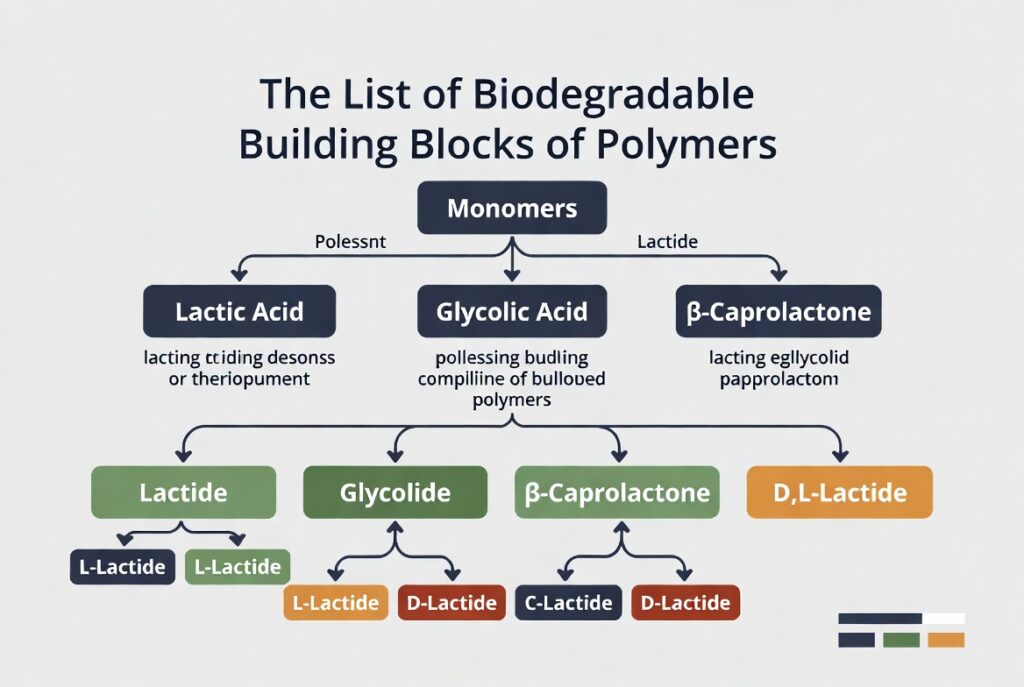
The accumulation of plastic waste is a global crisis. The solution lies in changing the building blocks of polymers from oil-based, persistent chemicals to bio-based, degradable ones.
Lactic Acid
-
The Source: It is produced by fermenting carbohydrates (corn, sugar beet).
-
The Polymer: Polylactic Acid (PLA).
-
Stereochemistry: Lactic acid exists in two forms (L- and D-). By controlling the ratio of these chiral building blocks of polymers, scientists can tune the degradation rate of the plastic from months to years.
Caprolactone
-
The Polymer: Polycaprolactone (PCL).
-
Flexibility: PCL has a very low melting point (60°C).
-
Medical Use: Because these building blocks of polymers break down harmlessly in the body, PCL is used for long-term drug delivery devices and dissolvable staples.
Hydroxybutyrate
-
The Natural Plastic: This is produced by bacteria (like Ralstonia eutropha) when they are under stress. They store carbon as polyhydroxybutyrate (PHB).
-
Properties: It behaves very similarly to Polypropylene but is 100% biodegradable. The challenge is the cost of extracting these building blocks of polymers from the bacterial cells.
Succinic Acid
This is a rising star in the bio-based world.
-
PBS: It reacts with 1,4-butanediol to form Polybutylene Succinate (PBS).
-
The Application: PBS is flexible and compostable, making it a leading contender to replace the building blocks of polymers used in single-use food packaging films.
6. The List of Essential Functional Groups
To truly understand how monomers become polymers, you have to look at their anatomy. The “hooks” that allow molecules to connect are called functional groups. These are the active sites on the building blocks of polymers.
-
The Double Bond (C=C): This is the “loaded spring” of polymer chemistry. In addition, polymerization (like PE, PP, PVC), a catalyst pops this double bond open. The electrons seek a new partner, grabbing the next monomer. Without this double bond, many building blocks of polymers would be inert.
-
The Hydroxyl Group (-OH): Found in alcohols. It is the key to forming polyesters and polyurethanes. It acts as a “donor” of structure.
-
The Carboxyl Group (-COOH): Found in organic acids. It reacts with alcohols to form esters or with amines to form amides. It is the “acid” half of the equation for many engineering building blocks of polymers.
-
The Isocyanate Group (-NCO): This is a highly reactive group used in polyurethanes (foams). It reacts aggressively with -OH groups.
-
The Epoxide Ring: A three-sided ring found in epoxies. The tension in this ring makes it want to snap open and react, which is why epoxy glues harden so quickly.
7. The List of Polymerization Mechanisms
Having the building blocks of polymers is one thing; assembling them is another. There are distinct strategies for building these chains.
Chain-Growth (Addition) Polymerization
Imagine a line of people holding hands.
-
Initiation: A “free radical” (a molecule with an unpaired electron) attacks the first monomer.
-
Propagation: The chain grows explosively fast. A chain of 10,000 ethylene units can form in a fraction of a second.
-
The Monomers: This method is almost exclusively for building blocks of polymers containing double bonds (Vinyls, Acrylates).
Step-Growth (Condensation) Polymerization
This is more like a mixer party.
-
The Process: Monomer A finds Monomer B, and they join (step 1). Then that pair finds another pair (step 2). The chain grows slowly and steadily throughout the mixture.
-
The Byproduct: Usually, a small molecule like water or HCl is ejected when the building blocks of polymers join. This “sweating” out of molecules is why it’s called condensation.
Ring-Opening Polymerization
Some building blocks of polymers are cyclic (shaped like rings), such as Caprolactam (for Nylon 6).
-
The Method: The reaction forces the ring to pop open into a straight line, which then connects to the next open ring. It is an elegant way to convert geometric tension into chemical bonds.
Copolymerization
Why stick to one block?
-
The Concept: By mixing two different building blocks of polymers (e.g., Styrene and Butadiene), you get a copolymer.
-
The Benefit: You get the best of both worlds. Styrene is hard but brittle; Butadiene is soft but weak. Combine them, and you get SBR (Styrene-Butadiene Rubber), which is durable enough for car tires.
8. The List of Additives (The “Helpers”)
Pure polymers are rarely useful. They might be too brittle, too soft, or degrade in sunlight. We add “helpers” to the building blocks of polymers to create the final commercial plastic.
-
Plasticizers: These are small molecules that sit between the polymer chains. They act like a lubricant, allowing the chains to slide. They turn rigid PVC (pipes) into flexible PVC (hoses).
-
UV Stabilizers: Sunlight is the enemy of the building blocks of polymers. UV rays can chop the polymer chains, causing the plastic to crack and fade. Stabilizers absorb this energy.
-
Cross-linkers: These agents build bridges between the long chains. Vulcanization of rubber is the most famous example, where Sulfur bridges tie the isoprene chains together. This prevents the building blocks of polymers from flowing, making the material heat-resistant and elastic.
-
Nucleating Agents: These help the polymer freeze (crystallize) faster and more evenly as it cools from a liquid, improving strength and clarity.
-
Flame Retardants: These chemicals interrupt the burning process. Since the building blocks of polymers are essentially solidified oil, they burn well. Retardants are essential for electronics and furniture safety.
9. The List of Safety & Regulations
We must address the elephant in the room. While polymers are generally safe, the building blocks of polymers (monomers) are chemically reactive and often toxic.
Residual Monomers
No reaction is 100% perfect. In any piece of plastic, there may be tiny traces of unreacted building blocks of polymers trapped inside.
-
The Risk: If these leach out into food or water, they can be harmful.
-
Regulation: Agencies like the FDA and EFSA set strict “migration limits” on how much monomer is allowed to move from the packaging to the food.
Specific Culprits
-
Bisphenol A (BPA): Banned in baby bottles in many countries due to its ability to mimic the hormone estrogen.
-
Vinyl Chloride: A proven carcinogen. Workers who manufacture the building blocks of polymers for PVC must be protected with heavy safety gear to avoid liver cancer.
-
Formaldehyde: Used in resins. It is a known respiratory irritant and carcinogen.
-
Phthalates: These are plasticizers, not monomers, but are often discussed in the same breath. They are endocrine disruptors used to soften PVC.
REACH and TSCA
-
REACH (Europe): A regulation that requires companies to prove the safety of the chemical building blocks of polymers they import or manufacture.
-
TSCA (USA): The Toxic Substances Control Act tracks industrial chemicals.
-
The Trend: There is a massive regulatory push to replace toxic building blocks of polymers with safer, bio-based alternatives.
10. The List of Future Building Blocks of Polymers
What will the materials of 2050 look like? Scientists are currently engineering the next generation of building blocks of polymers.
CO2-Based Monomers
Instead of letting carbon dioxide warm the planet, we are capturing it.
-
The Tech: Catalysts can coax $CO_2$ to react with epoxides.
-
The Result: Polypropylene carbonate. We are literally turning greenhouse gas into the building blocks of polymers.
Self-Healing Materials
Imagine a phone screen that fixes its own crack.
-
The Chemistry: These polymers contain “reversible bonds.” When the material cracks, the building blocks of polymers at the fracture site can chemically “hold hands” again, healing the wound. Supramolecular polymers are leading this field.
Conductive Monomers
Traditionally, plastics are insulators. But new building blocks of polymers like pyrrole and thiophene create plastics that conduct electricity.
-
The Future: Flexible solar panels, printable batteries, and artificial muscles made of plastic.
Smart/Responsive Blocks
These are building blocks of polymers that change shape in response to stimuli.
-
Stimuli: pH, temperature, or light.
-
Use Case: A drug delivery capsule that only opens when it detects the specific pH of a tumor, or clothing vents that open when you sweat.
FAQs: Building blocks of polymers
Here are the most frequently asked questions about the building blocks of polymers, presented for quick reference.
| Question | Answer |
| What exactly are the building blocks of polymers? | They are small molecules called monomers. When chemically bonded in repeating chains, they create polymers. |
| How do I identify the building blocks of polymers? | Look at the polymer name. “Polyethylene” means the building block is “ethylene.” “Polystyrene” comes from “styrene.” |
| Are natural building blocks of polymers better? | Not necessarily “better” in performance, but they are often more sustainable and biodegradable than fossil-fuel-based ones. |
| Can we mix different building blocks of polymers? | Yes! This is called copolymerization. It allows us to tune the properties of the material (e.g., making a brittle plastic tougher). |
| What happens to the building blocks of polymers during recycling? | In mechanical recycling, the chains stay intact. In chemical recycling, the chains are broken back down into the original monomers to be reused. |
| Why are some building blocks of polymers toxic? | Monomers are reactive by nature (they want to bond). This reactivity can interfere with biological systems if they enter the body. |
| What is the cheapest building block of polymers? | Ethylene is generally the cheapest and most available, derived from natural gas or oil refining. |
| Do all building blocks of polymers contain carbon? | Most do (organic polymers). However, silicones are based on Silicon-Oxygen inorganic building blocks of polymers. |
| How many building blocks of polymers are in a single chain? | It varies, but typically from 1,000 to over 100,000 units. The number of units is called the “degree of polymerization.” |
| What is the future of building blocks of polymers? | The industry is moving toward “Green Monomers”—sourced from algae, waste, or CO2—to create a circular economy. |
Conclusion
The story of the building blocks of polymers is the story of civilization’s material progress. From the early days of using natural rubber and cellulose to the Space Age explosion of synthetic engineering plastics, our ability to manipulate these tiny molecules has defined our era.
We have explored the diversity of these blocks—from the life-giving amino acids to the bullet-stopping aramids. We have seen how the arrangement of atoms in molecules like ethylene and propylene drives the global economy. We have also faced the challenges: the toxicity of monomers like vinyl chloride and the environmental persistence of the polymers they create.
But the future is bright. With the rise of bio-based building blocks of polymers, self-healing materials, and smart plastics, we are on the cusp of a new revolution. The next time you pick up a plastic bottle, look closer. It isn’t just “plastic.” It is a marvel of chemistry, a long chain of millions of tiny building blocks of polymers, locked together to serve a purpose.